


A serpentine belt that fails well before its scheduled interval is rarely the belt's fault alone. Pull the accessory drive apart in most workshops and the real cause appears quickly: a tensioner with a fatigued spring, or an idler pulley whose seized bearing burned the belt ribs from underneath. That is the practical reality of drive belt components. The belt takes the blame, but the hardware around it decides how long the belt survives. For distributors, workshop buyers, and parts managers, understanding how these parts behave as one system is the most direct way to reduce warranty claims and repeat repairs. This guide breaks down each component, the material decisions behind it, and the checks worth completing before you place a bulk order.
In an automotive engine, the drive belt system converts crankshaft rotation into motion for the accessories that keep the vehicle running: the alternator, water pump, A/C compressor, and power steering pump. A single serpentine belt weaves through all of them, and the system only works when four groups of parts do their jobs together.
When one part drifts out of specification, the others compensate until they cannot. A worn idler introduces misalignment; misalignment sheds belt ribs; missing ribs reduce grip; reduced grip creates slip and heat. That chain reaction is why experienced technicians treat the drive as a system rather than a single part.
The belt is the most visible component, and its rubber compound determines how it copes with the two forces that destroy belts in an engine bay: heat and ozone.
Most modern accessory belts use EPDM rubber, which resists heat aging and ozone cracking far better than the older chloroprene (CR) compounds. EPDM belts rarely show the deep chunk loss typical of chloroprene; instead they develop fine cracks across the rib surface, which is why crack-depth measurement rather than visual guesswork should decide replacement. CR belts remain common in industrial applications and on older vehicle platforms.
V-belts remain standard on industrial machinery, agricultural equipment, and older engine designs. Oil-resistant and dimensionally stable variants exist for environments with fuel mist, grease, or heavy shock loads, and matching the compound to the working environment matters more here than on a passenger car accessory drive.
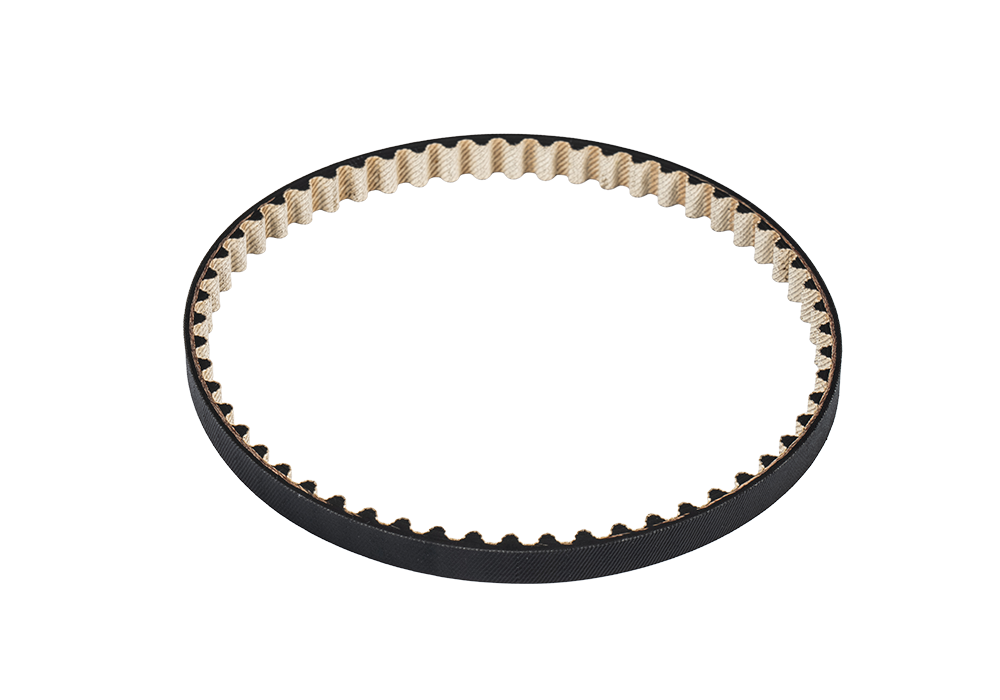
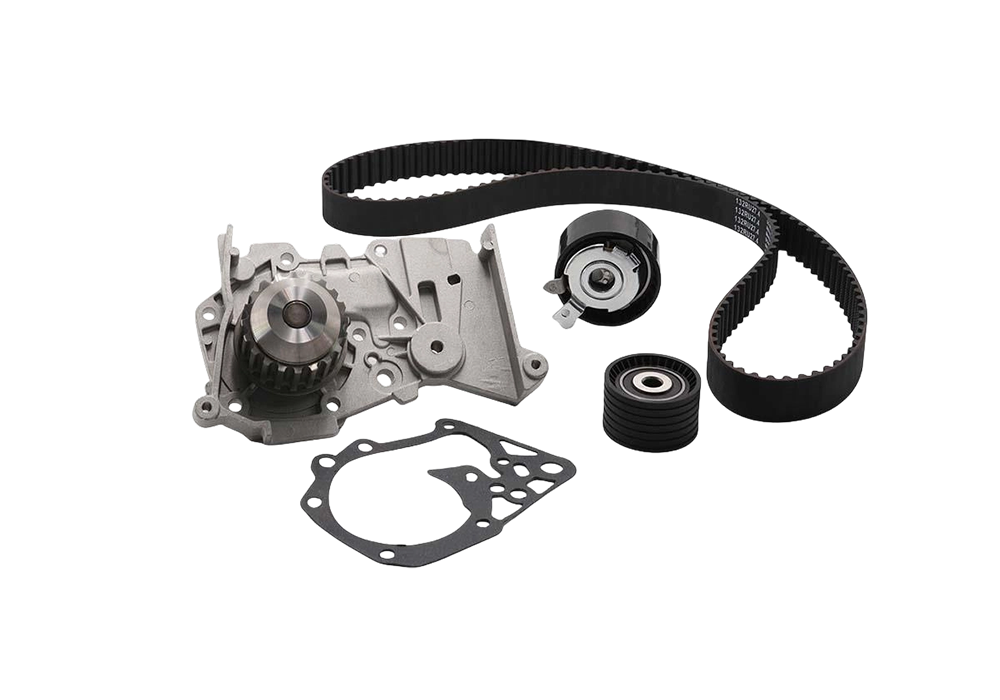
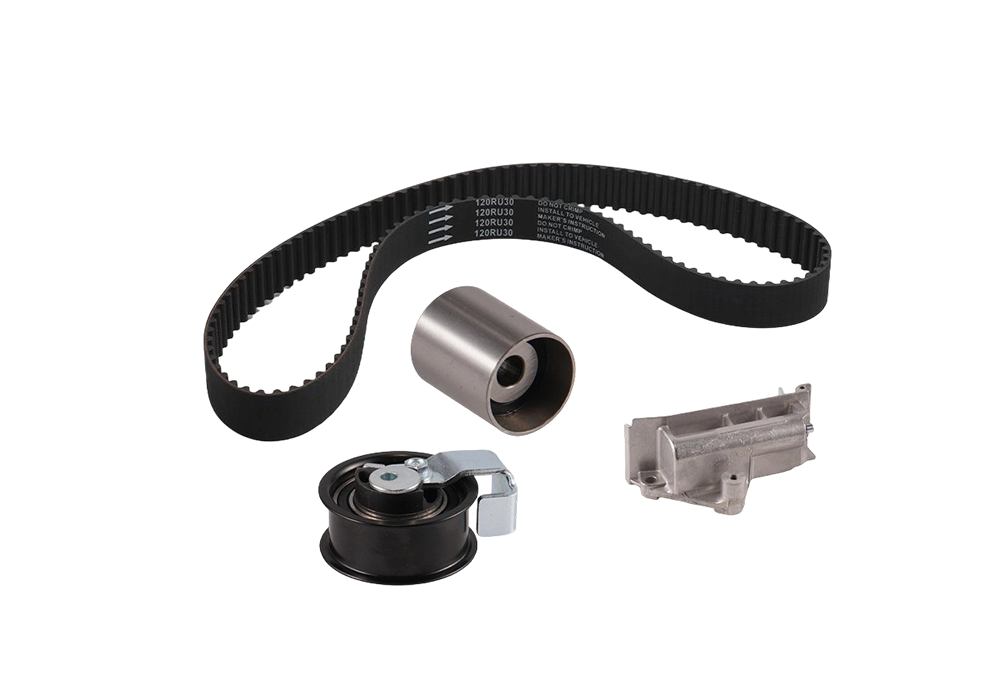
Where the belt synchronizes the camshaft with the crankshaft, tolerances are far tighter and the consequences of failure are far more expensive. HNBR compounds dominate modern timing belts because they tolerate higher under-hood temperatures and resist oil exposure better than standard chloroprene. If you are unsure where an accessory belt ends and a timing belt begins, the difference between a drive belt and a timing belt is covered in detail in our industry resources.
Conclusion first: if you can stock only one component alongside belts, stock tensioners, because tension accuracy affects every other part in the drive.
An automatic tensioner does three jobs at once. It presses the belt to the correct working tension so the ribs grip without slipping, it absorbs vibration and load spikes when accessories such as the A/C compressor cut in, and it takes up length change as the belt wears. Spring-loaded designs dominate passenger car accessory drives, while hydraulic damping appears on engines with heavier vibration.
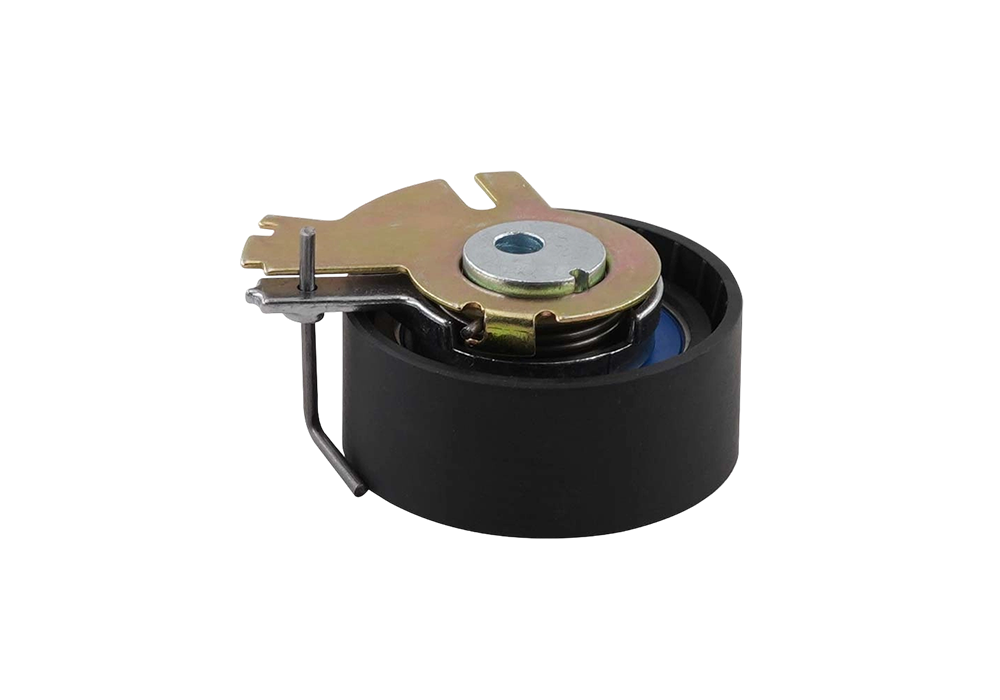 HERZ Drive Belt Tensioner with Ball BearingA spring-loaded automatic tensioner that maintains correct belt tension, absorbs load spikes, and takes up belt wear. Built-in molded ball bearings ensure smooth, low-friction rotation, addressing the chirps, rattles, and sticking travel described here.View Product →
Failure usually announces itself through the bearing rather than the spring. A chirp at cold idle that fades as the engine warms up, a rattle that tracks engine speed, or visible wobble at the tensioner pulley all point to the same underlying problem. A tensioner that has lost a noticeable share of its original travel, or that sticks mid-stroke instead of moving smoothly through its range, has already compromised the belt running over it.
Tension itself is a specification, not a feeling. Under-tension lets the belt slip and glaze; over-tension pushes alternator and water pump bearings beyond their design load. For procurement, bearing quality is the dividing line between a tensioner that lasts one belt cycle and one that reliably lasts two, so bearing specification belongs on the supplier checklist rather than being left to assumption.
Idler pulleys look like the simplest parts in the system, which is exactly why they get underestimated. Their job is geometric: guide the belt around obstructions, flip it so the ribbed or smooth face meets the correct pulley, and add wrap angle where a driven pulley needs more grip. In drive design, a pulley with insufficient wrap will slip no matter how good the belt is, so idlers exist to correct the geometry before it becomes a traction problem.
Material choice matters most at this level. Glass-fiber reinforced nylon idler pulleys deliver low weight, corrosion immunity, and quiet running, and they have become the default on many modern platforms. Their limitation is continuous heat: nylon compounds wear faster when mounted near turbochargers or exhaust routing. Steel pulleys tolerate higher temperatures but add rotating mass and depend entirely on coating quality for corrosion resistance.
 Glass Fiber Reinforced Nylon Drive Belt Idler PulleyMade of glass-fiber reinforced nylon 6/6 with molded ball bearings for quiet, corrosion-resistant running. A natural choice for modern platforms where weight and corrosion immunity matter, with the material limitations discussed in this section.View Product →
 High-Temperature Resistant Drive Belt Idler PulleyPrecision press-fitted bearing and housing deliver minimal rotational resistance and stable alignment. Suited to hot mounting locations near turbos or exhaust where standard nylon pulleys wear faster, as noted above.View Product →
The sealed bearing inside is the usual failure point. Spin each pulley by hand during inspection: any roughness or grinding means the bearing has lost its grease, and the pulley will seize without further warning. A seized idler at highway speed strips a serpentine belt in seconds and can simultaneously remove steering assist, charging, and water circulation. The inspection takes under a minute per pulley and prevents the most expensive failure mode in the entire drive.
Belt wear tells you where the system is failing, provided you know how to read it.
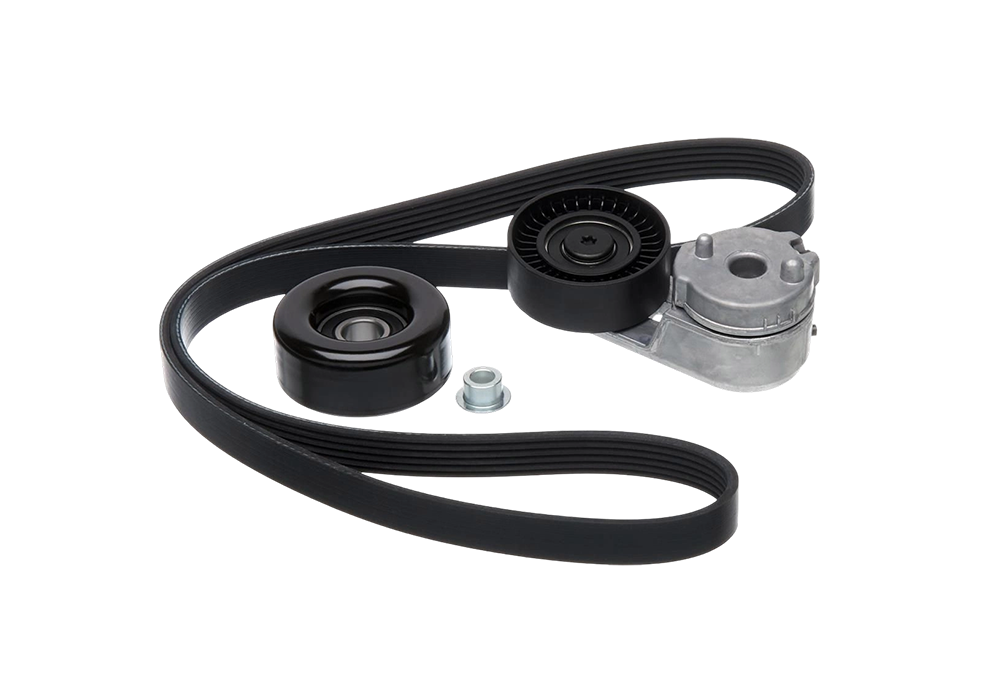
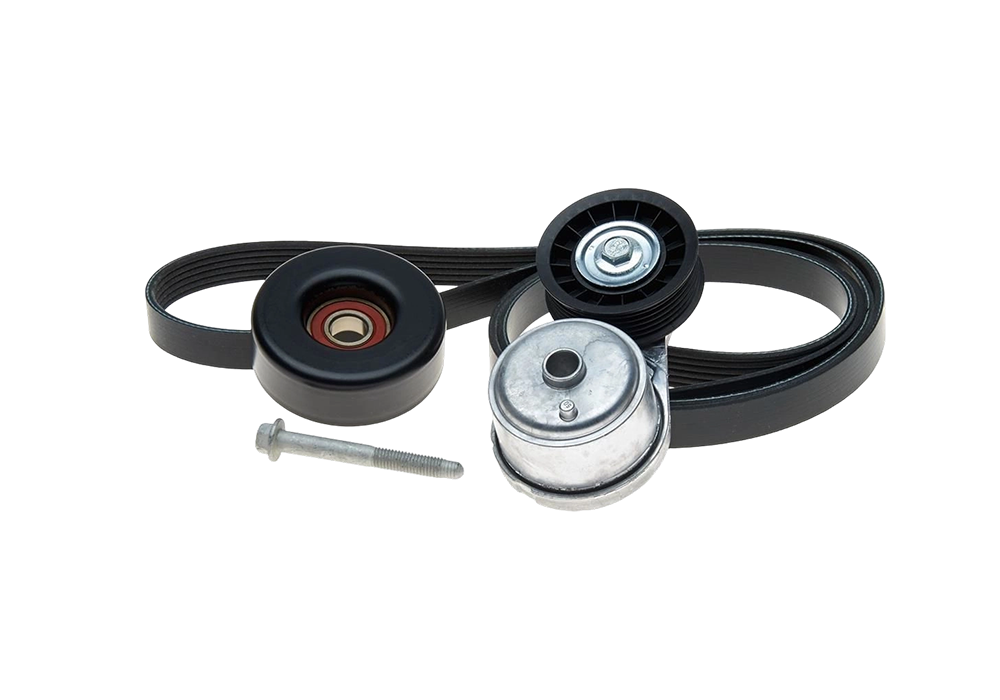
Because each component influences the others, vehicle manufacturers and experienced kit suppliers package the belt with its tensioner and idlers. Replacing the belt alone on a high-mileage engine is a false economy: the new belt runs over hardened bearings and misaligned geometry, and the vehicle returns with the same complaint weeks later. System-matched kits also simplify procurement, since one part number covers the entire service instead of five line items from different production batches.
The table below summarizes the four component groups, the materials typically used in each, and what technicians check first when a drive comes in with a noise complaint.
| Component | Common Materials | Typical Failure Mode | First Inspection Step |
|---|---|---|---|
| Serpentine belt | EPDM or CR rubber with fiber-reinforced cords | Rib cracking, glazing, chunk loss | Measure rib crack depth and check for glazing on the ribbed face |
| Timing belt | HNBR or CR with aramid or glass cords | Tooth shear or cord separation | Follow the vehicle manufacturer's replacement interval and check for oil contamination |
| Tensioner | Steel housing with spring or hydraulic damping and a ball bearing pivot | Bearing noise, spring fatigue, reduced travel | Watch for pulley wobble at idle and feel for sticking through the stroke |
| Idler pulley | Glass-fiber reinforced nylon or pressed steel with a sealed bearing | Bearing seizure, surface flaking, edge wear | Spin by hand and listen for roughness or drag |
For purchasers buying these components at wholesale scale, three checks prevent most after-sales problems.
Herz, a transmission products manufacturer based in Ningbo, China, produces belts, tensioners, and idler pulleys within one manufacturing system, supported by accessory belt kits in high-temperature and ozone-resistant variants. Sourcing the belt and its hardware from a single production system removes the mismatch risk described above, and Herz's complete drive belt portfolio gives distributors a practical way to consolidate those line items with one supplier.
Conclusion first: treat the drive as one system, match component materials to the heat and load profile of the application, and verify tension during installation rather than judging by eye. The belt is the cheapest part of the assembly and the one most often blamed for failures that actually started in a tensioner or idler pulley. Workshops that inspect the full drive at every belt replacement reduce comebacks; distributors who stock belts, tensioners, and idlers as matched sets reduce claims and simplify inventory. None of this requires new technology, only the discipline to treat a handful of small components as a single unit.


 English
 Español
 Português
 عربى
